How we scored them
Each format was scored out of ten across five axes, weighted towards the two that most often decide whether a product is worth buying at all — whether the halal claim is verifiable, and whether the dose matches the dose used in the research.
- Halal verifiability. Can you find the source animal and a named certifying body? Not a reassuring phrase — a certifier.
- Dose per serve. The trials that found effects used 2.5g to 5g of collagen peptides daily. Milligrams do not count.
- Evidence for the type. Type I and III underpin the skin, hair and nail research. Type II is a different story at a different dose.
- Format and adherence. The best supplement is the one still being taken in month three. Taste, texture and swallow count.
- Cost per effective serve. Price per gram of actual collagen, not price per tub.
1
Best overallHalal-certified bovine peptides (powder)
Type I & III · certified supply chain · 10g per serve
The only format in this list that can close the loop. Bovine collagen is permissible in principle; what matters is whether the animal was slaughtered to Islamic requirements, and whether anyone independent has checked. A certified supply chain means the answer is written down rather than implied.
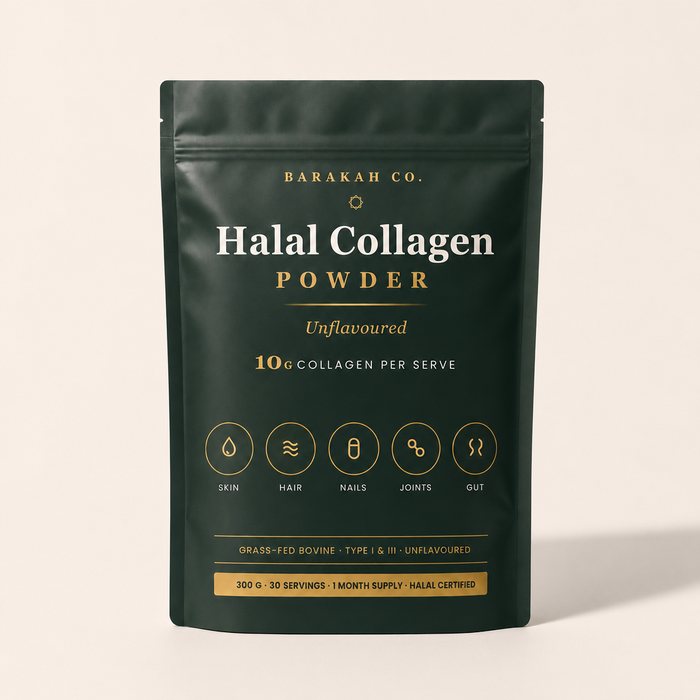
It is also, conveniently, the format the research is built on: unflavoured Type I & III peptides at a dose in grams, taken daily. The example we looked at most closely — Barakah Co. Halal Collagen — is certified end to end rather than at the finished-powder stage, runs 10g per serve, and has one ingredient on the back.
The catch is that certification costs money and that shows up in the price, though the current buy-one-get-one pricing puts it under a dollar a day.
What we liked
- Certified farm to sealed pouch, with the certifier named
- 10g of Type I & III peptides — comfortably above the trial dose
- Unflavoured and dissolves clear, so it survives month three
What we didn't
- Costs more than uncertified bovine powder
- Powder means you need water and ten seconds, unlike a capsule
Best if you eat fishMarine collagen (powder)
Type I · fish-derived · usually 5–10g per serve
Fish-derived collagen sidesteps the slaughter question entirely, which is why it is the default recommendation you will hear from other Muslim women. It is genuinely a good answer, and the peptides are small and well absorbed.
Two practical problems. It is Type I only, so it is a skin-and-nails product rather than a whole-structure one. And it tastes of fish — some brands more than others, and no amount of lemon in the glass entirely fixes it. Adherence at month three is where marine collagen quietly loses.
What we liked
- No slaughter question to resolve
- Small peptides, well absorbed
- Good evidence base for skin specifically
What we didn't
- Type I only — nothing for the Type III side
- Taste and smell defeat a lot of people by week six
- Typically the most expensive per gram
Uncertified bovine peptides (powder)
Type I & III · source stated, slaughter unstated
This is the biggest tier on the shelf and the most frustrating one. The dose is right, the collagen types are right, the price is usually excellent — and there is no way to establish how the animal was slaughtered.
Expect to find “grass-fed”, “pasture-raised” and “clean sourced” on the front. None of those is a halal claim. A handful of brands will answer directly if you email them; most will send you a paragraph that carefully does not say yes.
What we liked
- Correct types and usually a correct dose
- Cheapest per gram of collagen by a distance
- Widely available in supermarkets and pharmacies
What we didn't
- Slaughter method almost never disclosed or certified
- “Grass-fed” is repeatedly mistaken for a halal claim
Collagen capsules
Usually 500mg–1g per capsule, in a gelatine shell
3.8
/10
Shell is the problem
Capsules solve the taste problem and create two worse ones.
First, dose. A 500mg capsule is one fifth of the smallest dose used in the trials, so a genuine daily amount means five to ten capsules, which almost nobody sustains. Second, the shell itself is usually gelatine — which puts you back at the same question about the same animal, one layer out. Vegetarian HPMC shells exist and are worth looking for, but they are the minority.
What we liked
- No taste, easy to travel with
- Some brands use vegetarian HPMC shells
What we didn't
- Dose per capsule is a fraction of the trial dose
- Gelatine shells reintroduce the halal question
- Cost per effective gram is very high
Collagen gummies
Typically 1–2g per serve, plus sugar and a gelling agent
The most enjoyable and least defensible option in the category. Gummies need a gelling agent, and that agent is usually gelatine — most often porcine, because it sets better and costs less. Pectin versions exist and will say so proudly.
Even setting the gelatine aside, the dose is the issue: one to two grams a serve, alongside two to four grams of sugar. You would need a handful a day to reach the amount used in the research, and at that point you are eating sweets with a health claim on the jar.
What we liked
- People genuinely remember to take them
- Pectin-set versions do exist
What we didn't
- Gelling agent is usually gelatine, often porcine
- Dose far below the levels used in trials
- Added sugar in every serve
Avoid“Collagen boosters” and vegan collagen
Vitamin C, amino acids and botanicals — no collagen
1.9
/10
Contains no collagen
Worth being blunt: collagen is an animal protein, so there is no such thing as vegan collagen. These products contain the raw materials your body uses to make its own — vitamin C, glycine, proline, sometimes silica or bamboo extract — and are marketed with the word collagen in the largest type on the pack.
They are not a scam and they are not useless; vitamin C genuinely is required for collagen synthesis. But they are not the product the trials were run on, and buying one thinking otherwise is the most common mistake we see.
What we liked
- Suitable for vegetarians and vegans
- Vitamin C is genuinely required for collagen synthesis
What we didn't
- Contains no collagen at all
- Packaging routinely implies otherwise
- None of the skin or nail trials used these
A note on how this was assessed
Scores reflect the format as it is typically sold, assessed against published trial doses and against publicly available certification information. Individual products vary — a certified product in a weak format still beats an uncertified one in a strong format on the axis that matters most to you.
Muslimah Health may earn a commission on purchases made through links in this article. Commercial arrangements play no part in the scoring.